Menstrual Cycle Tracker Tool: Simplify period tracking and understand your body better. Take control of your health today!
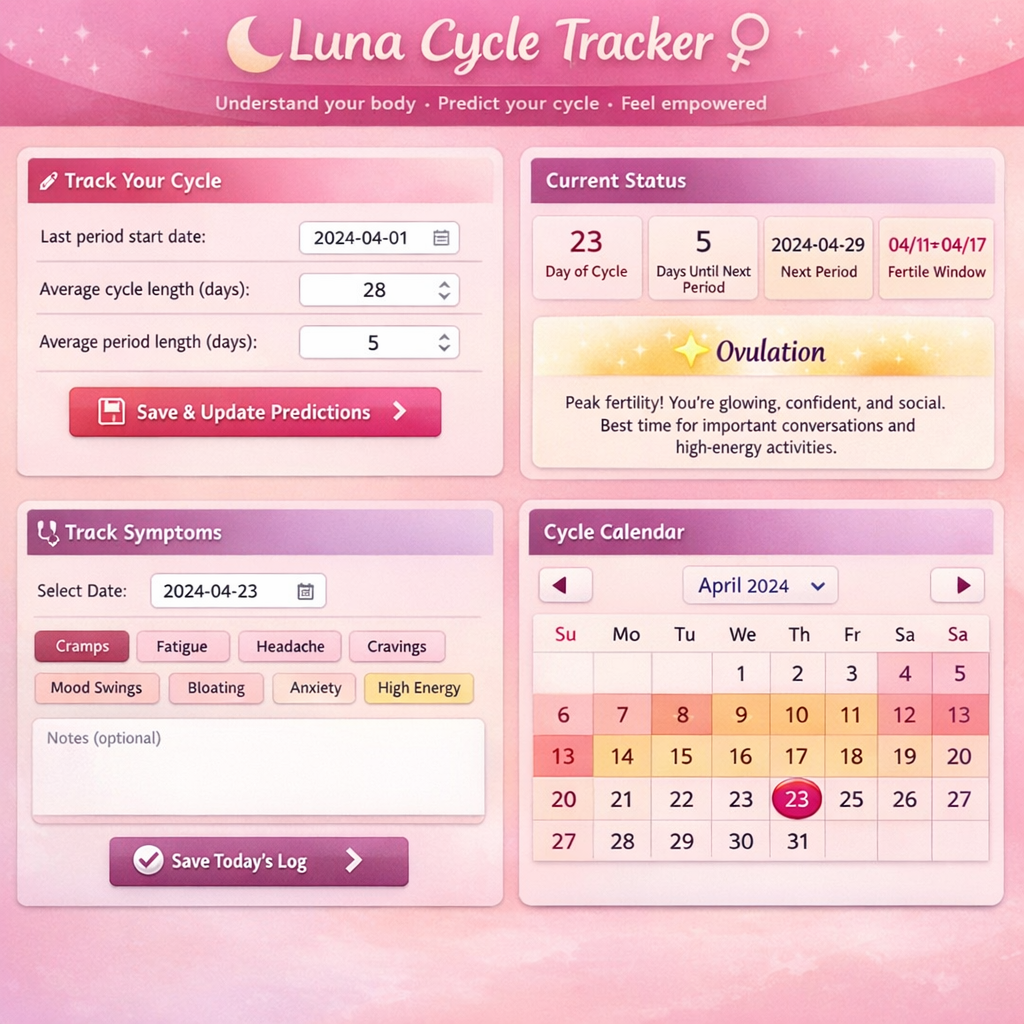
Luna Cycle Tracker
Understand your body · Predict your cycle · Feel empowered
Track Your Cycle
Current Status
Track Symptoms
Cycle Calendar
Cycle History
No history yet. Start tracking!
Wellness Insights
Daily Self-Care Tips
Cycle Length Trends
Track your cycle consistency over time
Luna Cycle Tracker Features:
- Cycle Tracking & Predictions
Track your last period start date
Predicts next period based on your average cycle length
Shows current day of cycle and days until next period
Identifies fertile window for planning
- Four Cycle Phases with Descriptions
🩸 Menstrual Phase – Rest and replenish
🌱 Follicular Phase – Energy rising, creativity peaks
✨ Ovulation – Peak fertility, confidence boost
🌙 Luteal Phase – Nesting, self-care focus
- Symptom Tracking
10 common symptoms with icons (cramps, fatigue, mood swings, cravings, etc.)
Daily notes section
Save symptoms for any date
View history with symptom logs
Delete/edit entries
- Interactive Calendar
Color-coded days (period in pink, fertile in orange)
Click any date to log symptoms
Shows current day highlighted
Month navigation
- Cycle Analytics
Cycle length trend chart showing your cycle consistency
Stores up to 12 months of cycle history
Visualize patterns over time
- Wellness Insights
Phase-specific advice and tips
Daily self-care tips
Educational content about each phase
- Data Persistence
All data saved in browser localStorage
Your history remains between sessions
No account needed – complete privacy
How to Use:
Set your last period date and average cycle length
View your current phase and predictions
Log symptoms daily by selecting from the grid
Check the calendar to see upcoming period predictions
Review history to track patterns
Use insights for self-care guidance
The tool provides a beautiful, empowering way to understand your menstrual cycle and take control of your reproductive health!
Table of Contents
Menstrual cycle tracking is a vital practice for understanding and managing reproductive health. This comprehensive guide explores the intricacies of menstrual cycles and the significant benefits of using tools like the Luna app for personalized tracking.
Learn about the cycle phases, how tracking can aid in fertility awareness, and its impact on emotional well-being.
Discover the Luna app’s features, including symptom logging and educational resources, and read user testimonials highlighting transformative experiences. With insights grounded in science and practical steps for effective use, this blog empowers individuals to take control of their menstrual health.
Embrace the future of health management through innovative technology and informed decision-making.
Introduction to Menstrual Cycle Tracking
Menstrual cycle tracking is the practice of keeping a record of the physiological and emotional patterns that occur throughout an individual’s menstrual cycle.
This process can involve noting the start and end dates of menstruation, the flow intensity, symptoms experienced, and other related factors such as mood, energy levels, and sexual activity. Understanding menstrual cycles can significantly enhance awareness of one’s body and wellbeing.
The significance of tracking one’s menstrual cycle extends far beyond mere observation. By gaining insights into the cyclical changes within the body, individuals can identify their health patterns and potential irregularities that may require medical consultation.
Furthermore, such tracking can support fertility awareness, making it a valuable tool for those planning to conceive or practicing natural family planning. Many users find that by recognizing ovulation periods and fertile windows, they gain better control over their reproductive health.
Additionally, understanding the menstrual cycle aids in anticipating and managing premenstrual symptoms, which many individuals experience. Knowledge of one’s cycle can provide a clearer understanding of emotional and physical changes, thereby enabling one to take proactive steps to mitigate discomfort. This degree of self-awareness often results in improved mental health and emotional well-being.
In essence, menstrual cycle tracking is not merely about observing when menstruation occurs; it is a comprehensive approach to understanding one’s body.
It empowers individuals with information that can lead to valuable lifestyle adjustments, enhanced reproductive health, and overall personal growth. By actively engaging in this practice, individuals are better equipped to navigate the nuances of their menstrual health.
Understanding the Menstrual Cycle
The menstrual cycle is a complex process that plays a crucial role in reproductive health. Typically lasting about 28 days, it consists of four main phases: the menstrual phase, follicular phase, ovulation, and luteal phase. Each phase is characterized by distinct hormonal and physiological changes that can significantly influence a person’s mood, energy levels, and overall well-being.
The menstrual phase marks the beginning of the cycle, lasting approximately 3 to 7 days. During this phase, the body sheds the uterine lining that had thickened in preparation for potential pregnancy.
The drop in estrogen and progesterone can lead to symptoms such as cramps, fatigue, and mood swings. Understanding these changes is vital for better management of discomfort during this time.
Following the menstrual phase is the follicular phase, which typically lasts from day 1 to about day 13. In this phase, the pituitary gland releases follicle-stimulating hormone (FSH), stimulating the growth of ovarian follicles.
As the follicles develop, they secrete estrogen, leading to an increase in energy levels and an uplift in mood. This phase is often associated with heightened creativity and motivation.
Ovulation occurs around the midpoint of the cycle, typically on day 14. The surge in luteinizing hormone (LH) results in the release of a mature egg from the ovary. This phase can result in a peak in libido and overall energy as the body is designed to encourage reproduction. However, some individuals may experience discomfort or ovulation pain during this time.
Finally, the luteal phase spans from day 15 to day 28. After ovulation, the ruptured follicle transforms into a structure called the corpus luteum, which secretes progesterone to prepare the uterine lining for potential implantation of a fertilized egg
If fertilization does not occur, hormone levels decline, leading back to the menstrual phase. Many experience premenstrual syndrome (PMS) during this phase, characterized by mood changes, bloating, and fatigue.
Key Features of the Luna App
The Luna menstrual cycle tracker app is designed with user-centric features that promote personalized health management. One of its standout functionalities is the personalized tracking of menstrual cycles. Users can input their cycle details, which helps the app to predict future cycles accurately
This predictive element is crucial for users seeking to manage their menstrual health effectively, identifying patterns and potential irregularities.
In addition to tracking cycles, Luna enables users to log various symptoms associated with their menstrual cycle. This feature is invaluable for those who experience symptoms such as cramps, mood changes, and fatigue. By recording these symptoms, the app provides insights into the relationship between specific symptoms and different phases of the cycle, enhancing self-awareness.
Furthermore, the app offers fertility predictions based on individual cycle data, which is beneficial for those trying to conceive
With accurate ovulation predictions, users can optimize their chances of pregnancy and better understand their fertility window. The integration of this feature with health data from other fitness applications ensures a comprehensive approach to health tracking.
Another noteworthy feature is the notifications system. Users receive timely reminders regarding important events, such as the start of their menstrual cycle or fertile windows, ensuring they are always informed and prepared. This proactive feature aids in maintaining a routine and managing health effectively.
Luna also serves as an educational platform, providing users with resources on menstrual health, reproductive education, and symptom management. This aligns well with the app’s goal of empowering women through knowledge and support, contributing to informed health decisions.
How to Use the Luna App Effectively
The Luna app is designed to help users track their menstrual cycles seamlessly, offering an array of features that promote awareness of personal health. To make the most of this powerful tool, follow these step-by-step instructions for setting up and utilizing the app effectively.
First, begin by downloading the Luna app from your device’s app store. Once installed, open the app and create an account. You will need to provide basic information, including your email address and a password. After completing this step, ensure you verify your email to confirm your account.
Once logged in, input your personal health data. This includes your average cycle length, the date of your last period, and any other relevant information that can help the app personalize your experience. Accurately entering your data is crucial for generating precise cycle predictions and health insights.
After submitting your personal information, you will have access to the symptom logging feature. This allows you to track various symptoms such as cramps, mood changes, or other physical conditions throughout your cycle. To log a symptom, simply navigate to the symptom tracking module, select from the provided options, and adjust the intensity or duration as needed.
Additionally, the Luna app serves as an educational platform, offering resources ranging from articles to videos about menstrual health. Exploring these materials can deepen your understanding of your cycle and enhance your overall wellness. Regularly check the app for updates, as new content is added frequently.
Incorporating these steps into your routine will ensure that you utilize the Luna app to its full potential, helping you gain valuable insights into your menstrual health.
In the digital age, data privacy has become a paramount concern for users of various applications, including those focused on menstrual cycle tracking.
As individuals increasingly rely on apps like Luna to monitor and understand their menstrual health, the protection of personal information is crucial. Menstrual cycle tracking apps, by their very nature, gather intimate health data that users expect to keep confidential.
Thus, Luna makes user privacy a top priority, implementing comprehensive measures to safeguard user data.
One of the foundational principles of Luna’s approach is user consent. The app ensures that all data collected is done so with the explicit permission of the user
This not only fosters trust but also empowers individuals to have control over their information. Users can easily manage their preferences regarding what data is shared and how it is utilized, thus maintaining autonomy over their health data.
Moreover, Luna employs advanced security protocols to protect sensitive information from unauthorized access.
Encryption techniques are utilized to ensure that user data is stored securely, preventing potential breaches and safeguarding against malicious intent. Regular security audits and updates are conducted to maintain a high standard of data protection, ensuring that vulnerabilities are promptly addressed
In addition, Luna does not sell user data to third parties, reinforcing its commitment to maintaining the integrity and confidentiality of personal health information.
Ultimately, data privacy is not merely a compliance issue; it is a fundamental aspect of building a trustworthy relationship between users and technology.
By prioritizing user consent, employing robust security measures, and eschewing data commodification, Luna positions itself as a responsible menstrual cycle tracker, dedicated to protecting the well-being and privacy of its users. Such dedication is vital in a world where data breaches are increasingly prevalent, and personal health information is more valuable than ever.
User Testimonials on Luna App
Many users of the Luna menstrual cycle tracker have reported transformative experiences that highlight the app’s efficacy in empowering women to better understand their bodies and health.
One user, Sarah, expressed that after using Luna for just a few cycles, she began to notice patterns that previously eluded her. “I used to dread my period, but now, thanks to Luna, I can anticipate my symptoms and plan accordingly. It has truly changed how I approach my cycle,” she shared.
Another user, Emily, emphasized the positive impact of tracking her cycle on her overall wellbeing. “The insights provided by Luna have helped me identify not just physical changes but emotional fluctuations as well. Understanding my cycle has encouraged me to seek healthier lifestyle choices, which has made a significant difference in my mood and energy levels,” she noted.
Furthermore, users have frequently mentioned how the app has facilitated improved communication with their healthcare providers.
For instance, Rachel, a long-term user, stated, “When I went to my doctor with my Luna data, it opened up a new level of understanding about my health issues. I could provide concrete insights that helped my doctor tailor my treatment plan directly to my needs.” Such testimonies highlight how menstrual cycle tracking has transcended mere date-keeping, evolving into a cornerstone of informed health decision-making.
Additionally, users also appreciate the educational content embedded within the app, which has enhanced their knowledge about reproductive health. Jenna remarked, “The articles on menstrual health made me feel more informed and confident in discussing my concerns with my doctor.
Luna has not only helped me track my cycle but has also educated me along the way.” These testimonials illustrate the multifaceted benefits of using the Luna app, encompassing emotional, physical, and educational dimensions of women’s health.
The Science Behind Menstrual Cycle Tracking
Menstrual cycle tracking is an essential practice grounded in scientific principles that provide valuable insights into an individual’s reproductive health.
The menstrual cycle is a complex interplay of hormonal changes, primarily regulated by the hypothalamus, pituitary gland, and ovaries, occurring over an average duration of 28 days, although it can range from 21 to 35 days. Understanding these hormonal fluctuations is crucial for effective cycle tracking.
At the beginning of the cycle, the body experiences low levels of estrogen and progesterone, which trigger the shedding of the uterine lining during menstruation. As the cycle progresses, rising levels of estrogen stimulate the growth of the uterine lining in preparation for potential pregnancy.
This increase in estrogen is followed by a surge in luteinizing hormone (LH), which triggers ovulation, marking a key phase in fertility awareness methods
Tracking these hormonal changes not only guides individuals in predicting ovulation but also enhances awareness of fertile windows, thus enabling informed family planning.
Furthermore, menstrual cycle tracking offers additional health insights. By documenting various cycle-related symptoms such as mood swings, physical discomfort, and changes in discharge, individuals may identify patterns that suggest underlying health issues or hormonal imbalances.
This data becomes particularly significant in assessing conditions like polycystic ovary syndrome (PCOS) or endometriosis, where irregularities in the cycle are prevalent. In essence, the practice transcends mere observation, fostering an understanding of one’s body and promoting proactive healthcare strategies.
Overall, the science of tracking menstrual cycles not only enhances fertility awareness but also empowers individuals with knowledge about their reproductive health, turning intimate biological processes into actionable insights for improved well-being.
Addressing Common Myths About Menstrual Cycle Tracking
Menstrual cycle tracking has gained popularity in recent years, yet several myths and misconceptions continue to surround this essential practice. One prevalent myth is that tracking is only necessary for those trying to conceive
While it is undoubtedly helpful for identifying fertile days, understanding one’s cycle can benefit all menstruators. It can provide valuable insights into one’s health, helping to identify irregularities or other potential issues that may arise.
Another common misconception is that menstrual cycles are always regular. The truth is that cycle length can vary greatly among individuals and even between cycles for the same person. Factors such as stress, diet, exercise, and hormonal changes can influence cycle regularity.
By keeping a detailed record of their cycles, individuals can better understand their bodies and recognize any irregularities, which may warrant a discussion with healthcare providers.
Some also believe that menstrual cycle tracking is not a reliable contraception method. While cycle tracking can assist in identifying fertile windows, it is essential to note that it is not foolproof. Variability in ovulation timing and other factors can lead to the risk of unintended pregnancies if used solely as a contraceptive method.
Therefore, it is advised to use tracking in conjunction with other forms of contraception for more effective pregnancy prevention.
Lastly, many people think that menstrual cycle tracking is complicated and requires extensive knowledge. However, with modern apps like Luna, users can efficiently track their cycles with user-friendly interfaces that simplify the process.
These features allow users to log symptoms, moods, and other relevant data, making cycle tracking more accessible and informative than ever before.
Conclusion and Future of Menstrual Tracking
As we reflect on the significance of menstrual cycle tracking, it becomes evident that applications like Luna play a crucial role in empowering individuals to manage their menstrual health effectively.
By providing insights into their cycles, users gain a deeper understanding of their bodies, which allows them to anticipate hormonal fluctuations, manage symptoms, and enhance their overall well-being.
Tracking menstrual cycles is no longer viewed merely as a necessity; it has evolved into an essential aspect of comprehensive health management for individuals across various stages of life.
The future of menstrual health management technology appears promising with continuous innovations aimed at enhancing user experience and health outcomes. With advancements in machine learning and artificial intelligence, menstrual tracking apps are poised to become more personalized and intuitive.
These technological improvements may include predictive analytics that can forecast menstrual symptoms based on individual cycle patterns, thereby facilitating timely interventions and promoting proactive health management.
Moreover, the integration of menstrual tracking with wearable technology is an area ripe for exploration. Devices that monitor physical health metrics may support synchronization with cycle-tracking apps, providing a holistic view of health.
Such innovations would not only help in understanding menstrual patterns but would also enable users to connect various aspects of their health, from stress levels to overall physical fitness.
As society becomes increasingly aware of the importance of menstrual health, advocacy for accessible and informative tools will gain momentum.
Ultimately, the combination of advanced technology, personalized insights, and user-friendly interfaces promises to usher in a new era of menstrual health management, making tools like Luna invaluable partners for every individual on their health journey.
Here are some calculators maybe you need in your life
Heart Rate Zone Calculator For You: Regularly reassess your heart rate zones, especially after significant progress or changes in your fitness routine. This ensures that your training remains effective and aligned with your current capabilities.
Menstrual Cycle Tracker Tool: To Simplify period tracking and understand your body better.